
4th IWGoRS Workshop
June 20, 2016 – June 23, 2016
About the Workshop
The 4th IWGoRS workshop will be held at the Evangelische Akademie Tutzing (near Munich, Germany), June 20-23, 2016. The workshop will focus on any aspect of rotational ground motion including the recording of rotations, instrumentation, earthquake sources, non-standard rheologies, inverse problems, geodesy, earthquake engineering, long-period seismology, array-derived rotation, noise-correlation studies, ring laser technology, Earth’s rotation, problems of fundamental physics and others. The meeting is co-funded by the ERC project ROMY and the ESF project TIDES.
Scientific Committee
- Prof. Ullrich Schreiber (TU Munich, Germany), ring laser technology
- Prof. Frank Vernon (IGPP, La Jolla, USA), array methods
- Prof. Johana Brokesova (Charles University Prague, Czech Republic), instrumentation, applications
- Prof. Johan Robertsson (ETH Zurich, Switzerland), exploration applications
- Dr. Vladimir Graizer (NRC, USA), instrumentation
- Prof. Zbig Zembaty (Opole University, Poland) Earthquake engineering
- Prof. Heiner Igel (LMU Munich, Germany), wave propagation, inverse problems
- Dr. Celine Hadziioannou (LMU Munich, Germany), ambient noise
- Dr. Stefanie Donner (LMU Munich, Germany), seismic source
- Dr. Joachim Wassermann (LMU Munich, Germany), array seismology, instrumentation
- Prof. Jon-Paul Wells (Univ. Christchurch), New Zealand, ring laser physics
- Prof. Bor-Shouh Huang (Univ Taiwan), array methods, experiments
- Prof. Toshiro Tanimoto (UC St. Barbara), long-period seismology
- Dr. John Evans (USGS, Menlo Park), instrumentation
Local Organizing Committee
- Dr. Joachim Wassermann
- Prof. Heiner Igel
- Dr. Stefanie Donner
- Dr. Felix Bernauer
- Dr. Celine Hadziioannou
Venue
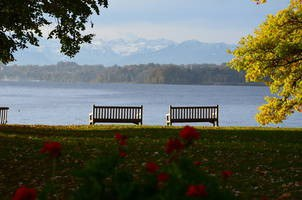
The meeting will be held at the Evangelische Akademie Tutzing, a conference center located in the small town of Tutzing at the shore of the Starnberg lake near Munich. Tutzing can be reached from the Munich Airport by commuter train (duration approx. 1:25 hrs). Info is available at http://reiseauskunft.bahn.de (also in English). If you arrive at the Munich Airport follow the signs to the trains. Buy a ticket to “Tutzing”. Take train S1 (direction München-Ost) and get off at Munich-Laim (after approx 40 mins). Change to platform 1 and take train S6 (direction Tutzing) and get off at Tutzing (after approx. 40 mins.). Follow the signs to the “Evangelische Akademie Tutzing”. The following graphic shows the way to the venue (10 mins walk). Please get in touch if you have questions.
Programme
A provisional programme with allocated oral talks and poster session is accessible here (click on the relevant links).
| Mon June 20 | Icebreaker | ||
| Tue June 21 | Oral presentations | Oral presentations | |
| Wed June 22 | Oral presentations | Poster session | Conference Dinner, Boat trip |
| Thu June 23 | Oral presentations |
Presentations
Belfi, Jacopo et al.: Recent activity on the GINGERino ring laser gyroscope
Bernauer, Felix: Testing a Prototype Broadband fiber-optic Gyro
Di Virgilio, Angela: Discussion on the ring-laser sensitivity and accuracy
Evans, John R.: Portable sensors for rotational ground motion
Holt, William et al.: Wave Gradiometry and Helmholtz Solution Correction Applied to USArray
Igel, Heiner: The ROMY Project – ROtational ground Motions: a new observable for seismologY
Jaroszewicz, Leszek R. et al.: Teleseismic rotational measurements
Kozak, Jan T. and Petr Jedlicka: New model of ring liquid sensor for rotational ground displacement
Lin, Chin-Jen et al.: 10 components of waveform at Pinon Flat Observatory (PFO), California
Liu, Kui et al.: A large-scale passive laser gyroscope based on ultra-stable lasers
Schreiber, Ulrich et al.: Ring Lasers for Geodesy and Seismology
Tanimoto, Toshiro: Seismic Noise in Rotation Data
Wells, Jon-Paul and Ulrich Schreiber: Rotation Sensing with Lasers
Posters
Salvermoser, Johannes et al.: An Event Database for Rotational Seismology
Sollberger, David et al.:Rotational seismograms on the Moon
Van Renterghem, Cederic et al.:Wavefield separation using spatial wavefield gradient estimates
Costs and registration
Thanks to the sponsoring through the ERC project ROMY there are no registration fees. The costs listed below cover accomodation and full board for 3 days. Icebreaker reception, special Bavarian Conference Dinner, an evening boat trip on the Starnberger lake (midsummer night!), coffee breaks throughout the meeting are covered.